I have had the honor of helping with Results Canada for the past 1.5 years. During that period, I have witnessed the amazing work our organization is doing to advocate worldwide action to battle the illness, raise awareness, and gather support through digital initiatives like #StopTB and #YesWeCanEndTB. My dedication to this cause stems from my awareness of the importance of advocating for health-related concerns and the mission to end poverty, as well as the profound effects that these initiatives may have on communities, especially Tuberculosis (TB) community.

Improving Results Canada’s Digital Advocacy for Tuberculosis (TB) – By Dipanpreet Kaur
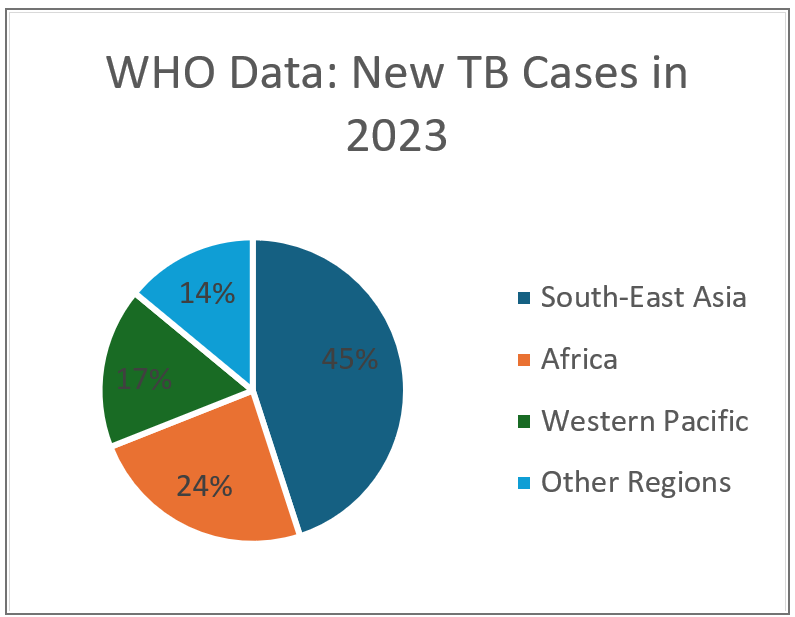
Despite being raised in a family that has always had access to healthcare, my experience growing up in India enabled me to observe firsthand the difficulties faced by impoverished populations, especially when it comes to getting essential medical treatment. Inadequate healthcare facilities and poor sanitation leave many people susceptible to illnesses like tuberculosis (TB), which should otherwise be easily avoided. As you can see in the pie chart above that in 2023, the WHO South-East Asia Region had the highest percentage of new TB cases (45%), followed by the African Region (24%), and the Western Pacific Region (17%). This indicates the global burden of TB and the pressing need for focused efforts in these regions.
Despite my early diagnosis and subsequent treatment, my viewpoint is still shaped by the emotional and physical difficulties my parents and I encountered together. My commitment to spreading awareness about tuberculosis, particularly in poor areas, is strengthened by this personal experience. I have witnessed the impact of a lack of resources and access to healthcare, particularly in areas where monthly wages might be as low as $33. My dedication to supporting TB patients, especially those living in poverty, has been influenced by these events.
In the video below, I relate my personal story as a TB survivor to the need to include storytelling videos from current TB patients. I also talk about the physical and mental challenges I had as a kid in this video.
In 2023, “A total of 1.25 million people died from Tuberculosis (TB),” as reported by the WHO, making digital campaigning more important than ever. In article “Tuberculosis,” Furin, et al. mentioned, “Global tuberculosis incidence is estimated to be slowly declining by 1·6% per year, far from the 4-5% estimated to be required to reach WHO’s End TB Strategy targets” (pp. 1942). In other words, the global rate of new TB cases is declining at a relatively slow pace of 1.6% year, which is far less than the 4-5% required to reach the WHO’s TB end objectives. This logistic emphasizes how urgent it is to act strongly and effectively. Although, Results Canada’s today’s digital advocacy initiatives are praiseworthy, we must tweak the digital culture of our organization’s website to address the scope of the issue. Through this we can accelerate our progress toward these global goals and significantly improve the lives of individuals who are still suffering from TB by putting more interactive and localized initiatives into practice. Increasing our digital outreach through creative tactics will be essential to advancing our efforts to abolish tuberculosis by 2030, one of the health priorities of the United Nations Sustainable Development Goals (SDGs), as it is a leading cause of death globally.
Results Canada has advanced significantly in using online mediums to increase the reach of its advocacy work. The website uses the rhetorical triangle, that is, ethos, pathos, and logos to establish an emotional bond with its viewers and support the message’s legitimacy. Incorporating calls to action (CTAs), statistical data, and engaging narratives from videos of TB volunteers and survivors develops public involvement, empathy, and trust. However, there are a few ways the Results Canada website’s digital culture may be improved to increase its impact as we work to eradicate tuberculosis by 2030.
To improve our digital culture and bolster our advocacy work, I would like to give three suggestions:
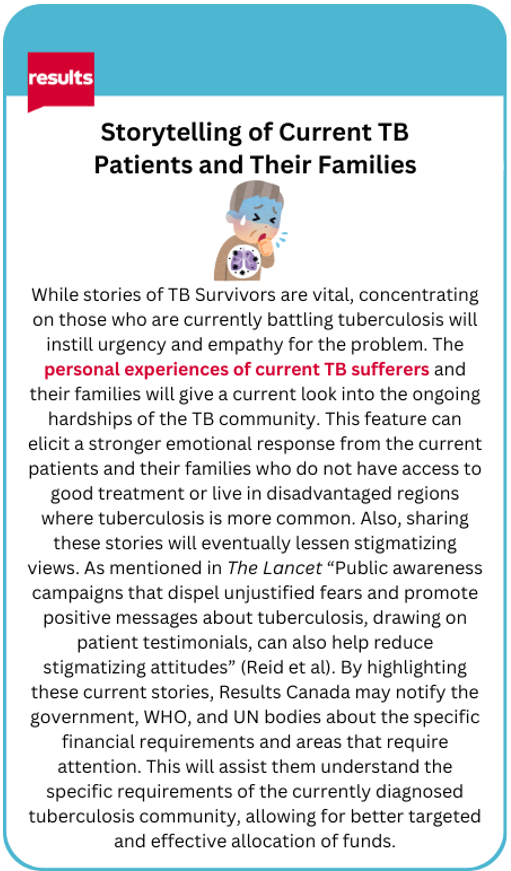
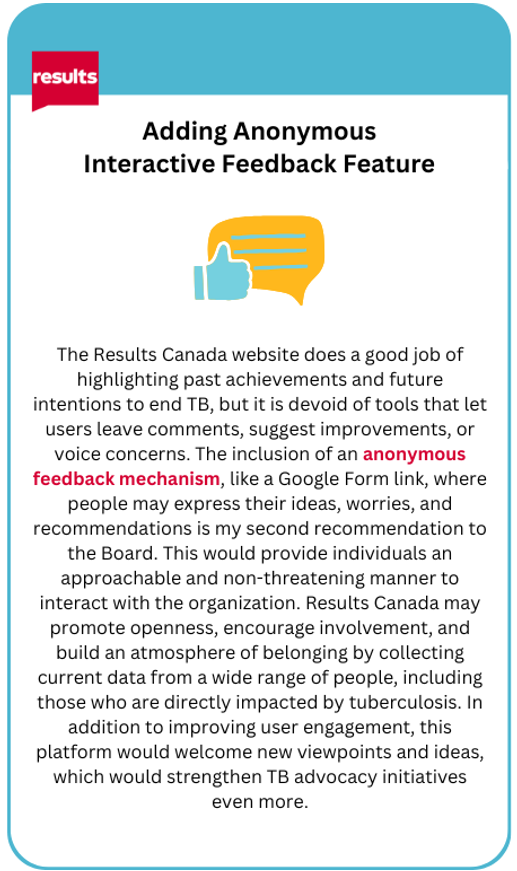
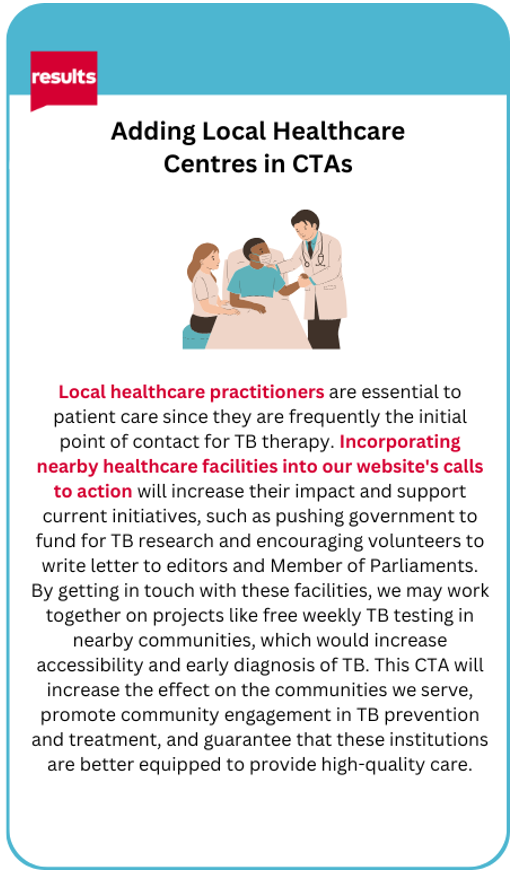
The Results Canada website’s digital culture will be greatly improved by putting these suggestions into practice, becoming more engaged, inclusive, and sensitive to the requirements of TB patients. The website can offer a more urgent and humanized view of the difficulties experienced by people who are still battling tuberculosis by including the personal stories of them and their families. By including a feedback platform, a direct channel for public participation will be established, facilitating more cooperation and openness. By collaborating with nearby healthcare facilities in our calls to action, we can guarantee that TB treatment is efficiently managed at the local level, enhancing care coordination and inspiring communities to combat TB. In addition to strengthening the feeling of community surrounding TB advocacy, these improvements will guarantee that the website’s digital culture supports our goal of having a significant, real influence on the worldwide fight against tuberculosis. Therefore, I say to the Board that improving the website’s digital culture in these ways, we can increase the efficacy of our advocacy activities by bolstering our capacity to help TB sufferers at all levels and encourage real-world action.
Works Cited
Canada, Results. 2024, March: #YesWeCanEndTB, Accessed 17 Nov. 2024.
https://resultscanada.ca/wp-content/uploads/March-2024-CTA-YesWeCanEndTB-EN-and-FR_compressed.pdf
Dudina, V. “Digital Health Activism of Patients with Chronic Diseases: Discursive Strategies and Themes.” European Journal of Public Health, vol. 32, no. Supplement_3, 2022,
https://doi.org/10.1093/eurpub/ckac131.186
Furin, Jennifer, et al. “Tuberculosis.” The Lancet (British Edition), vol. 393, no. 10181, 2019, pp. 1642-,
https://doi.org/10.1016/S0140-6736(19)30308-3
Organization, World Health. “Tuberulosis (TB).” World Health Organization, 29 Oct. 2024,
https://www.who.int/news-room/fact-sheets/detail/tuberculosis
Reid, Michael J. A., et al. “Building a Tuberculosis-Free World: The Lancet Commission on Tuberculosis.” The Lancet (British Edition), vol. 393, no. 10178, 2019, pp. 1331–84,
https://doi.org/10.1016/S0140-6736(19)30024-8